TL;DR

Get comfort and recovery gear delivered free with Prime
- Fast, free delivery on millions of items
- Prime Video, Amazon Music and more included
- Member-only deals all year
Fit&Well reports that Boston-based Pilates instructor Julie Erickson recommends a three-exercise sequence: roll up and roll down, swan prep, and spine twist. Erickson says regular practice may support mobility and back strength, but the report provides no comparative evidence that the routine is the quickest way to improve posture or reduce stiffness.
Boston-based Pilates instructor Julie Erickson recommends a sequence of three Pilates movements—roll up and roll down, swan prep, and spine twist—for people seeking to work on posture and stiffness. The routine was reported by Fit&Well, which says Erickson believes regular practice can support mobility and back strength; the report does not establish that it is the quickest approach or provide evidence comparing it with other routines.
The sequence addresses the spine and torso through controlled bending, extension, and rotation. Fit&Well presents it as an option for people who spend extended periods sitting at a desk or looking down at a phone. Those activities are the report’s rationale for focusing on posture, rather than evidence that this particular routine reverses harm.
For the roll up and roll down, the instructions call for sitting with legs extended, then slowly rolling the torso down and curling back up, before folding forward over the legs and returning to sitting. The suggested amount is eight to 10 repetitions. The report offers a modification: roll down only halfway or secure the feet under a strap or couch.
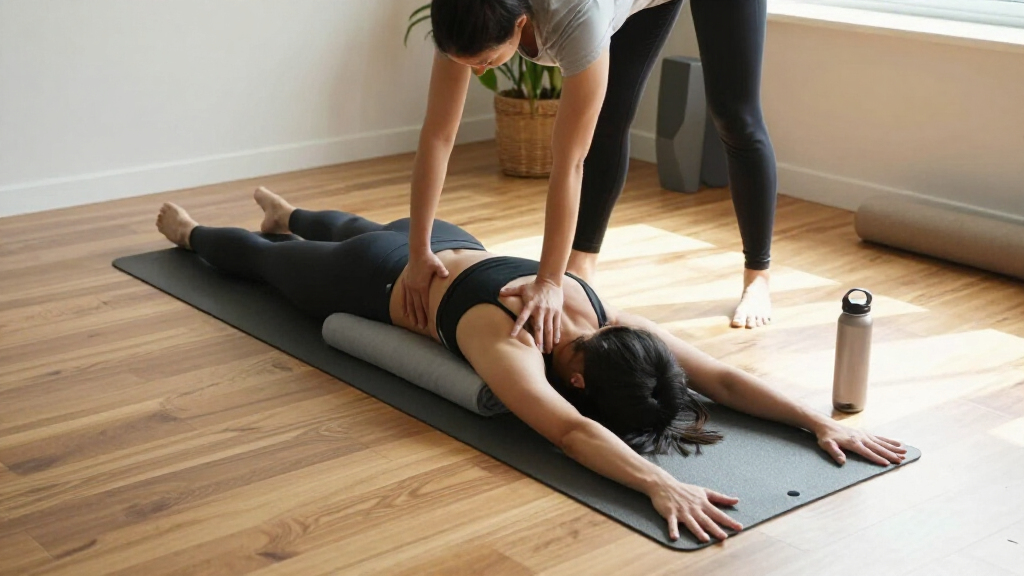
For swan prep, lie face down with palms beside the ribs, press into the hands, lift the chest while drawing the shoulders back, and lower slowly. Fit&Well lists five repetitions and describes lifting higher or straightening the arms as a harder variation. The final move, spine twist, is performed seated with legs extended: rotate the ribcage to each side while keeping the hips and lower back still, for five repetitions per side.
A Short Sequence for Desk Stiffness
The routine is a compact set of movements that can be adapted in difficulty, which may make it useful to readers looking for a structured starting point. Its three actions target different kinds of spinal movement, rather than asking someone to repeat a single exercise.
But the framing needs care: the headline’s “quickest way” is not supported by comparative results in the supplied report. Erickson’s recommendation is expert guidance attributed to an instructor, not a clinical finding or a guarantee of improved posture. Readers should treat the claimed benefits as potential support for mobility and strength, not as a promised outcome.
As an affiliate, we earn on qualifying purchases.
How the Three Moves Work
Fit&Well introduces the exercises against a familiar pattern: long periods at a desk and frequent phone use can involve sustained positions. Erickson, founder of Endurance Pilates and Yoga in Boston, suggests the sequence as a way to add spinal movement and back-muscle work.
The report supplies step-by-step instructions and repetition counts, but does not describe a study, a trial, or a measurement of posture or stiffness. It also does not specify how often to do the routine, how long improvement might take, or what standard was used to call it the quickest approach. The recommendation is therefore best understood as a practical exercise suggestion, not a tested ranking of posture programs.
“Done regularly, it can restore mobility and strengthen your back, making it easier to sit and stand upright.”
— Julie Erickson, Boston-based Pilates instructor and founder of Endurance Pilates and Yoga, as quoted in Fit&Well
As an affiliate, we earn on qualifying purchases.
Evidence Behind the Speed Claim
The supplied report does not explain what makes this routine the “quickest”, define a timeframe for improvement, or compare it with other exercises. It does not include measurements, research findings, or accounts from people who completed the sequence. The extent to which an individual might experience changes in posture, mobility, or stiffness is also not established.
Practical details are limited as well: the report gives repetition counts but no recommended weekly frequency or progression schedule. It does not set out individualized guidance for people with pain, injuries, or other health concerns. The article presents the moves as general exercise instructions, not a personalized assessment.
As an affiliate, we earn on qualifying purchases.
How Readers Can Use the Guidance
Readers who want to try the sequence can follow the listed repetitions and use the easier roll-down option or the stated swan-prep modification when needed. The instructions emphasize slow, controlled movement, including keeping the hips still during the twist. The supplied source does not give a formal schedule, so it does not support a specific promise about how quickly results could appear.
Anyone with persistent discomfort, an injury, or a condition that affects movement can seek guidance from a qualified health professional or Pilates instructor before starting. No additional study, follow-up, or measured outcome is identified in the source; whether the routine produces the claimed benefits, and how it compares with other options, remains open.
As an affiliate, we earn on qualifying purchases.
Key Questions
Which exercises are in the routine?
Fit&Well lists the roll up and roll down, swan prep, and spine twist.
How many repetitions does the report recommend?
It suggests eight to 10 roll ups and roll downs, five swan preps, and five spine twists on each side.
Is it proven to be the quickest way to improve posture?
No comparative evidence is included in the supplied report. “Quickest” is the framing of the headline, not a conclusion established by a study in the article.
What modifications does the report suggest?
For the roll up and roll down, it suggests rolling down only halfway or securing the feet under a strap or couch. It describes lifting the chest higher or straightening the arms as a harder swan-prep variation.
Does the report say how often to do the sequence?
No. It gives repetitions for each movement but does not specify a weekly frequency or a timeframe for seeing changes.
Source: rss
Halloween Picks
halloween
As an affiliate, we earn on qualifying purchases.