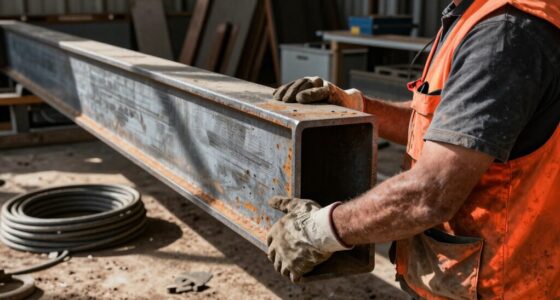
Just because something looks strong on the surface doesn’t mean it’s truly stable or safe. Visual cues often hide internal issues like cracks, corrosion, or poor design that weaken the structure. True stability depends on internal factors and proper assessment, not just appearances. Relying only on looks can give you false confidence. To truly understand stability, you need to explore deeper tests and inspections—there’s more to uncover beyond what meets the eye.

Get comfort and recovery gear delivered free with Prime
- Fast, free delivery on millions of items
- Prime Video, Amazon Music and more included
- Member-only deals all year
Key Takeaways
- “Looks strong” relies on external appearance, which may hide internal weaknesses or flaws.
- “Is stable” refers to actual structural integrity and capacity to withstand forces.
- Visual cues alone cannot reveal hidden issues like internal cracks or corrosion.
- True stability requires thorough testing and internal assessments beyond surface appearance.
- Superficial evaluations can be misleading; foundational inspections are essential for accurate stability assessment.

You might think that something looks strong just because it appears sturdy or solid, but appearances can be deceiving. When you rely solely on visual perception, you might assume a building, a bridge, or even a piece of furniture is stable because it looks well-constructed or robust. But visual cues don’t always tell the full story about an object’s actual stability. Structural integrity—the ability of a structure to withstand loads and forces without failing—is key to understanding whether something is truly safe and durable. Just because something looks tough doesn’t mean it can bear weight or resist stress effectively.
Appearances can be deceptive; true stability depends on unseen factors like quality and design, not just looks.
Our eyes are great at noticing surface details, like the thickness of a wall or the width of a beam, but they can’t measure internal strength or the quality of materials used. For example, a wooden beam might appear solid and well-finished, yet if it’s riddled with internal cracks or made from compromised wood, it might not hold up under pressure. Similarly, a metal frame may look sleek and shiny, but if it’s poorly welded or has hidden corrosion, its actual structural integrity is compromised. The challenge is that visual perception is often superficial—focused on what is immediately visible—while the true stability of a structure depends on unseen factors like material quality, design, and how forces are distributed.
To accurately determine whether something is stable, you need more than just a glance. Engineering assessments and testing are necessary to verify if a structure can handle stress, weight, and external forces over time. This might involve stress tests, material analysis, or examining internal components that aren’t visible to the naked eye. When you understand the difference between looks and stability, you become better at assessing risks and making informed decisions. You recognize that a seemingly sturdy appearance may mask underlying weaknesses, and that true stability comes from sound engineering and quality materials.
Furthermore, understanding material quality is essential to evaluating real stability, since subpar materials can compromise the entire structure despite a strong appearance. When you comprehend this, you are better equipped to identify potential issues before they escalate. Recognizing the importance of structural assessment allows for a more comprehensive evaluation beyond superficial appearances, ensuring safety and durability. Additionally, considering testing methods can provide concrete evidence of a structure’s true strength, reducing the risk of failure. It’s also important to remember that material fatigue over time can weaken a structure even if it initially appears solid, highlighting the need for ongoing inspections. Conducting regular inspections is crucial to catch signs of deterioration early and prevent unexpected failures.
In everyday life, this awareness helps you avoid false confidence in things that appear solid but aren’t. Whether it’s checking the foundation of a house before buying or inspecting the load-bearing parts of equipment, understanding the distinction between visual perception and actual structural integrity makes you safer and more cautious. Remember, what looks strong can sometimes be superficial—real stability requires deeper investigation. Don’t be fooled by appearances; always seek evidence of true strength before trusting something with your safety or investments.
structural integrity testing tools
As an affiliate, we earn on qualifying purchases.
As an affiliate, we earn on qualifying purchases.
Frequently Asked Questions
How Can I Tell if Something Is Truly Stable or Just Looks Strong?
You can’t rely solely on aesthetic illusions or visual deception to judge stability. To tell if something’s truly stable, test it physically—check for weight distribution, balance, and how it responds under pressure. Looks can be deceiving, so don’t trust appearances alone. Instead, perform real-world assessments, like gently applying force or observing its behavior over time, to determine if it’s genuinely stable or just giving a strong impression.
What Are Common Signs That a Structure Looks Strong but Isn’T Stable?
You might notice a structure that has impressive aesthetic appeal but isn’t truly stable if it relies on visual illusions like exaggerated shapes or overly polished surfaces to appear strong. Look for signs like uneven surfaces, cracks, or imbalanced proportions, which can hide underlying weaknesses. Just because it looks strong, doesn’t mean it’s stable—trust structural assessments over visual impressions to guarantee safety.
Why Do Some Objects Appear Strong but Are Actually Unstable?
Imagine gazing at a towering skyscraper that seems unshakable, yet hidden cracks threaten its stability. You see aesthetic illusions and visual deception—an object might appear robust due to design or surface finish, but underlying flaws or poor foundation make it unstable. Sometimes, a surface’s strength or grandeur masks vulnerabilities, leading you to trust appearances over actual stability, which can be deceptive and dangerous.
How Does Material Choice Affect Stability Versus Appearance?
Material choice considerably impacts stability and appearance. Durable materials like steel or reinforced concrete enhance stability, ensuring structures withstand forces over time. However, they may not always match aesthetic perception, which often favors lighter, more refined materials like glass or wood. When selecting materials, you balance durability for safety and stability with aesthetic appeal, understanding that a visually appealing object might not always be mechanically stable without proper support or design.
Can Something That Looks Weak Be More Stable Than It Appears?
Like a vintage jukebox hiding its cracked veneer, something that looks weak can be more stable than it appears. Your aesthetic illusion and visual perception might deceive you, but stability doesn’t rely solely on looks. A structure or object can seem fragile yet be designed with hidden reinforcements or resilient materials. Always assess the actual stability, not just the appearance, because appearances can be deceiving, even in the digital age.
material analysis kit for construction
As an affiliate, we earn on qualifying purchases.
As an affiliate, we earn on qualifying purchases.
Conclusion
So, next time you observe something that looks strong, remember it might not be stable—appearances can deceive. Sometimes, it’s just a coincidence that what seems firm holds steady, while true stability often goes unnoticed. Trust your instincts, but also look beneath the surface; what looks solid might be fragile, and what’s stable might not be obvious at first glance. In life, appearances and reality often dance a delicate, unpredictable dance.
As an affiliate, we earn on qualifying purchases.
As an affiliate, we earn on qualifying purchases.
Halloween Picks
halloween
As an affiliate, we earn on qualifying purchases.