
TL;DR
Personal trainer Anneli Marinovich shared a 10-minute resistance-band routine featuring pull-aparts, glute bridges and bird dogs. The source says to consult a health professional about back pain before trying new exercises; the routine is not established here as a treatment or guaranteed prevention method.
Fit&Well has published a 10-minute resistance-band routine from personal trainer and menopause coach Anneli Marinovich, featuring pull-aparts, glute bridges and bird dogs. Marinovich says the exercises focus on the back, glutes and core, but the report advises people to consult a health professional about back pain before trying new movements.

Get comfort and recovery gear delivered free with Prime
- Fast, free delivery on millions of items
- Prime Video, Amazon Music and more included
- Member-only deals all year
The suggested workout uses a long loop resistance band and, ideally, a short loop band, as in these resistance-band exercises. The report says to complete three rounds, resting for 45 seconds between rounds. It does not provide research showing that this specific routine prevents or treats lower-back pain.
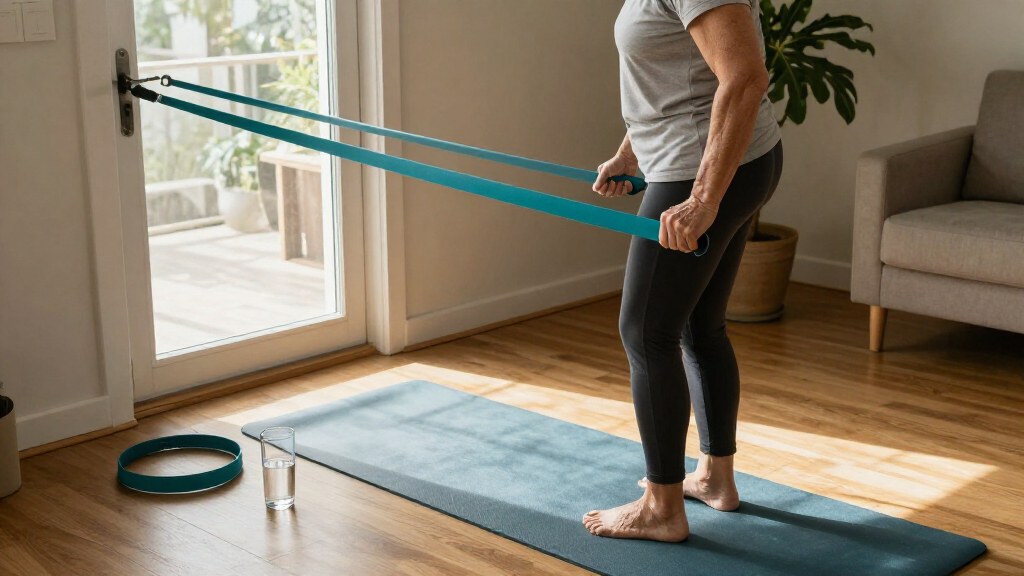
For the pull-apart, hold the long band in front of the chest with both hands and pull outward while bringing the shoulder blades together. The suggested count is 10 repetitions, returning slowly to the starting position after a brief pause.
For the glute bridge, lie on your back with knees bent and a short loop above the knees. Press the lower back gently toward the floor, push through the heels to lift the hips, and press the knees outward against the band. The routine calls for 10 repetitions, holding each bridge for two seconds before lowering with control.
A Routine Built Around Support
The exercises offer readers a short, equipment-light way to work on back, glute and core strength. Those muscles contribute to posture and stability during everyday movements, although the source does not establish that performing this workout will keep pain away or prevent falls.
The distinction matters because lower-back pain can have different causes, and an exercise suitable for one person may not be appropriate for another. The report itself recommends professional advice before starting exercises when back pain is present. Readers should treat Marinovich’s routine as general fitness guidance, not an individualized care plan or a substitute for assessment.
Products Worth Considering

Dyson Ball Animal 3 Upright Vacuum

Levoit Core 600S-P Smart Air Purifier for Large Rooms

Sonos Arc Ultra Soundbar with Dolby Atmos, Black
As an affiliate, we earn on qualifying purchases.
How the Three Moves Fit Together
The routine’s third exercise is the bird dog: start on hands and knees with a flat spine, then extend one arm forward and the opposite leg behind. Hold for two seconds while keeping the torso and hips steady, return to the start and alternate sides. The source recommends five repetitions per side.
Marinovich describes the program as a shift away from abdominal exercises focused on appearance and toward what she calls the “posterior armour”—the back, glutes and deep stabilizing muscles. That is her description of the workout’s emphasis, rather than a clinical conclusion reported by Fit&Well.
““This move teaches the body to stabilise the spine against movement, which is essential for balance and fall prevention.””
— Anneli Marinovich
Limits of the Reported Advice
The source does not state when the article was published, cite clinical studies supporting the specific sequence, or report outcomes from people who followed it. It also does not specify how readers should modify the exercises for differing levels of fitness, mobility or pain.
Marinovich presents the routine as a way to strengthen supporting muscles and reduce discomfort, but the source does not confirm that it prevents or treats back pain. Anyone with pain, a health condition or uncertainty about whether an exercise is suitable should seek guidance from a qualified health professional.
Check Suitability Before Starting
The next step for readers is to ask a doctor or physical therapist whether strength training—and these movements in particular—is suitable for their circumstances. If a health professional approves, the routine as described is three rounds, with 45 seconds of rest between rounds and the listed repetitions for each movement.
The source gives no follow-up schedule, progression plan or advice for symptoms that arise during exercise. It also does not say whether further reporting or evidence about the routine is expected.
Key Questions
What exercises are in the routine?
It includes resistance-band pull-aparts, banded glute bridges and bird dogs.
How many rounds does the workout recommend?
The report recommends three rounds, with 45 seconds of rest between rounds.
Does the routine guarantee lower-back pain prevention?
No. The source describes the workout as aimed at strength and reducing discomfort, but does not establish that it prevents or treats back pain.
Should I try the exercises if I have back pain?
The report advises consulting a health professional before trying new exercises for back pain.
Source: fitandwell.com