
TL;DR
A Fit&Well report describes a workout method used in training discussed by actor Alison Brie and trainer Jason Walsh: hold a position against resistance, then perform repetitions of the same movement. The report also offers a four-round home routine designed by personal trainer Mark Harris; the full exercise list in the supplied material is incomplete.
Alison Brie’s trainer Jason Walsh described a strength-training technique that pairs an isometric hold with repetitions of the same exercise, according to an interview with Brie published by Women’s Health and covered by Fit&Well. The report also presents a four-round home workout assembled by personal trainer Mark Harris, offering readers a way to try the method without copying Brie’s reported heavy lifts.

Get comfort and recovery gear delivered free with Prime
- Fast, free delivery on millions of items
- Prime Video, Amazon Music and more included
- Member-only deals all year
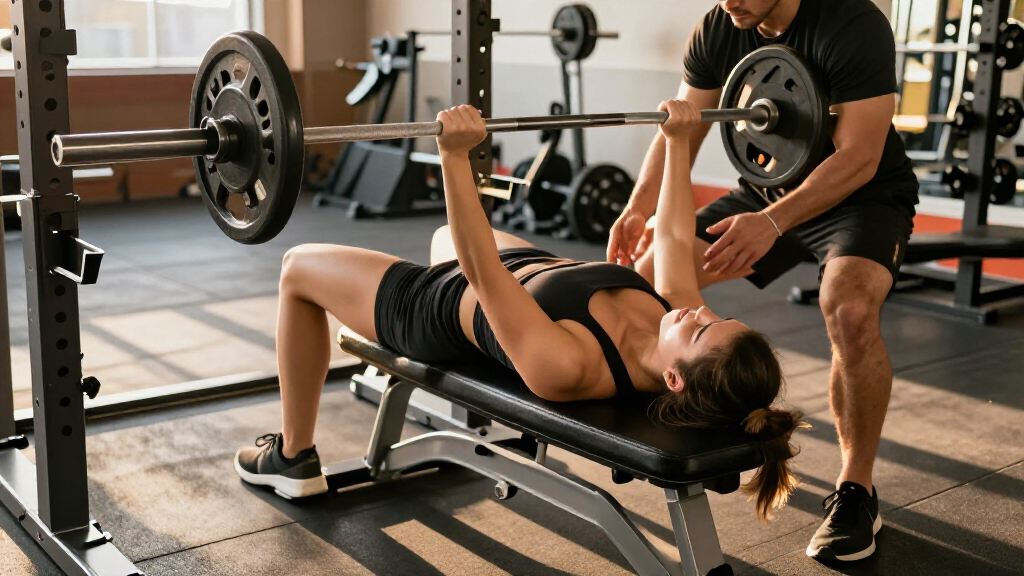
In an isometric exercise, a person contracts a muscle while holding a position rather than moving through repeated motion. In the workout Walsh discussed, Brie pushed against a fixed bar from a Zercher squat position before performing Zercher squats with a barbell. Walsh said the hold recruits the nervous system and can build strength without necessarily adding size. That is his explanation of the method, not a guarantee of the same result for everyone.
Fit&Well reports that Brie began strength training about 15 years ago, after working with actor Emily Blunt, and increased her training while preparing to play a wrestler in the series GLOW. The article gives weighted pull-ups with 45-pound plates as one example of her strength work. Those details describe Brie’s routine; they are not instructions for beginners to attempt the same loads.
For a more accessible version, Harris recommends doing each hold first, then immediately completing the corresponding repetitions, with minimal rest before moving to the next exercise. After all four exercises, rest for 60 to 90 seconds and repeat until four rounds are complete. The source material lists a 30-second goblet squat hold followed by 10 goblet squats, a 10-second push-up hold followed by 10 push-ups, and a 15-second bent-over-row hold followed by 10 rows. It begins describing a fourth exercise but does not include its details.
A Hold Before Each Strength Set
The format gives readers a specific way to change a familiar strength session: instead of moving straight into repetitions, they pause under tension at a selected point in the movement. Harris says this can help people practice bracing and balance and work on a difficult position in a lift. That makes the technique relevant to people who want a structured variation on bodyweight or dumbbell exercises, though the article does not provide evidence that it produces a particular result for every trainee.
The distinction between Brie’s training and the suggested home session matters. Brie’s reported weighted pull-ups and barbell work reflect her own training history and preparation; they should not be treated as a baseline. Harris’s workout uses lighter, adaptable movements, and the source explicitly allows a kneeling push-up variation. Readers can adjust the load and range of motion to their ability rather than trying to reproduce an actor’s routine.
Products Worth Considering

eufy Security 5-Piece Home Alarm Kit

Philips Hue Bridge Pro Starter Kit with 4 A19 E26 Color Smart Bulbs

Roborock F25 BX Cordless Wet/Dry Vacuum Cleaner
As an affiliate, we earn on qualifying purchases.
From Brie’s Training to Home
The report links the technique to an interview in which Brie discussed her training with Walsh. Brie is 43 in the source article, which describes her as having built strength over years of training and after preparing for a wrestling role. The report does not say that one technique alone caused her strength, and its headline’s reference to getting strong in her 40s should be read alongside the longer training history it describes.
Harris, identified by Fit&Well as a Level 4 personal trainer and strength and conditioning coach, supplied the home workout. Its first three listed pairs are a goblet squat hold and repetitions, a push-up hold and repetitions, and a bent-over row hold and repetitions. For the push-up, the article says people can put their knees on the floor to use a kneeling variation. It does not provide the remaining fourth exercise in the material supplied here.
“It recruits the nervous system at such a high rate that you can get really strong without getting bigger.”
— Jason Walsh, Alison Brie’s trainer, as quoted in the Women’s Health video described by Fit&Well
Limits of the Workout Report
The supplied report does not include the full instructions for the fourth exercise, so the routine cannot be reproduced exactly from the available details. It also does not provide a study, measured outcomes or a comparison group supporting the claims about strength gains, joint wear or muscle growth. Walsh’s and Harris’s explanations should be understood as attributed coaching advice, not established outcomes for every person.
The article does not specify what weight readers should use, how to progress the workout, or whether the routine is appropriate for someone with an injury or health condition. A hold should be challenging but controlled, and readers should stop if they feel pain. People with existing health concerns or uncertainty about exercise suitability should seek guidance from a qualified health professional or trainer.
Use the Method With Care
Readers who want to try the format can begin with a manageable load and a version of each movement they can perform with control, then follow a hold with the listed repetitions. The source recommends four rounds and 60 to 90 seconds of rest between rounds, but does not give a progression plan or the missing fourth exercise. Fit&Well would need to publish those details for the complete routine to be followed as written.
For now, the confirmed takeaway is the structure: hold, then perform repetitions of the same movement. Brie’s reported training illustrates how the method appeared in her sessions, while Harris’s examples offer scaled movements. Neither the report nor the interview establishes that this technique alone explains her strength or promises comparable results.
Key Questions
What is an isometric hold?
It is a muscle contraction held in place without moving the joint through repetitions. The report’s examples include holding the bottom of a squat or pausing near the bottom of a push-up.
How does the workout pair holds and repetitions?
Harris’s format places an isometric hold before repetitions of the same movement, with minimal rest before the next exercise. The listed examples include a 30-second goblet squat hold followed by 10 squats.
Did this technique alone make Alison Brie strong?
The source does not establish that. It says Brie had strength-trained for about 15 years and increased her training for GLOW; Walsh described the hold-and-repetition method as one part of her workout.
Can beginners adapt the suggested exercises?
The report gives a kneeling push-up option and presents the routine as a home workout. It does not set beginner loads, so use a manageable version, maintain control and seek qualified guidance if you are unsure whether an exercise is suitable.
Source: rss