TL;DR

Get comfort and recovery gear delivered free with Prime
- Fast, free delivery on millions of items
- Prime Video, Amazon Music and more included
- Member-only deals all year
Fit&Well published a three-exercise kettlebell routine intended to take about 10 minutes and train core stability at home. Certified kettlebell specialist Faith Ellis recommends beginning with a manageable weight, prioritizing form and increasing the challenge gradually; the report does not provide research testing the routine or a timed schedule for all its sets and reps.
Fit&Well has outlined a three-move kettlebell workout for people seeking to train core stability at home, featuring a half-kneeling halo, a single-arm suitcase carry and a dead bug pullover variation. The outlet attributes the exercise selection and beginner progression advice to Faith Ellis, a certified kettlebell specialist and founder of The KettleBelle; the report presents the routine as a 10-minute option, but does not give a timed schedule for completing every prescribed set and rep.
The program prescribes three sets of each exercise. For the half-kneeling halo, Ellis’s instructions specify four circles in each direction on each side, starting with a 10–18 lb (4–8 kg) kettlebell. The person kneels with one knee down and the opposite foot planted, holds the bell by its horns at chest height, then circles it around the head while keeping the hips square. The movement is listed as working the obliques, shoulders, upper back and deep core.
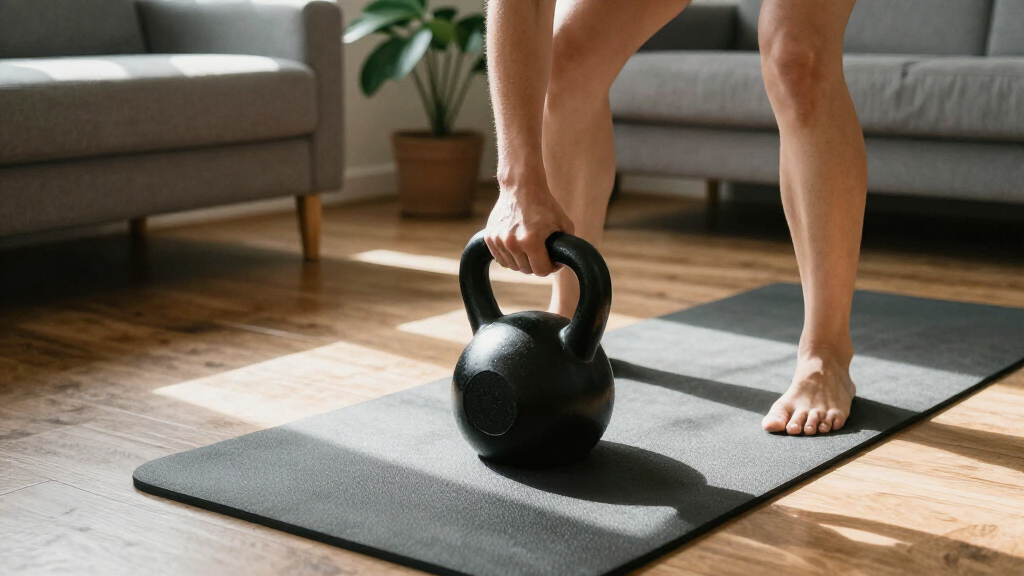
The second exercise is a single-arm suitcase carry: walk for 30 seconds holding the kettlebell at one side, then switch hands. Fit&Well gives a suggested starting weight of 18–26 lb (8–12 kg) and calls for three sets, describing the targets as the obliques, transverse abdominis and posture stabilizers. The report recommends a controlled pace and heel-to-toe steps.
For the final move, the kettlebell dead bug, the source prescribes six to eight repetitions per side for three sets, starting at 10–18 lb (4–8 kg). Lying on the back with knees bent over the hips, hold the bell above the chest, keep the lower back pressed into the floor, and lower one leg as the arms move the bell behind the head. Return to the starting position and alternate sides. Ellis advises increasing weight by 4–8 lb (2–4 kg), adding repetitions or slowing the movement only once a set feels easy and can be completed with good form.
A Short Routine Built Around Stability
The workout gives readers a specific at-home sequence rather than a general recommendation to strengthen the core. Its three movements ask the trunk to stay controlled while the arms or legs move, and the carry adds a walking component. That offers a practical alternative for people with a kettlebell who want a brief routine without gym equipment beyond the weight.
Ellis’s explanation centers on the difference between stabilizing the trunk and repeatedly bending the spine. She says single-arm and offset exercises require the core to resist rotation and side bending. That is her rationale for the selection; Fit&Well’s report does not cite a study showing that this particular combination produces a measured strength outcome or works for every person.
The progression guidance also makes the routine more usable for beginners: start with a light-to-medium bell, focus on breathing and a neutral spine, and add difficulty in small steps. The practical takeaway is not that 10 minutes guarantees a particular result, but that consistent, controlled practice can be organized into a compact home session.
Products Worth Considering

Ring Alarm 8-Piece Kit (2nd Gen) Home Security System

eufy Security Essential 7-Piece Alarm System

Ring Alarm 14-Piece Wireless Security System
As an affiliate, we earn on qualifying purchases.
Ellis’s Beginner Training Guidance
Fit&Well frames a kettlebell as a versatile home-training purchase, quoting Ellis’s view that one weight can support strength, mobility and cardiovascular work. The report then focuses specifically on deep trunk stability and presents three beginner-friendly moves. No publication date or independent evaluation of the routine is supplied in the source material.
The recommendations include different starting loads for different exercises, not one universal kettlebell weight. Ellis advises readers who are new to exercise to begin with a light-to-medium load and increase it only after they can perform the set with sound form. Her suggested increments are 4–8 lb (2–4 kg), or people can add repetitions or slow the reps instead. These are the source’s coaching suggestions, not individualized medical or fitness advice.
“Kettlebell exercises require the core to stabilize and transmit force rather than just flex the spine.”
— Faith Ellis, certified kettlebell specialist and founder of The KettleBelle, as quoted by Fit&Well
Timing and Results Are Not Tested
The source calls the session a 10-minute workout, but its listed volume is three sets of each move, with repetitions or carry time for each. It does not explain whether the 10-minute estimate includes rest, transitions between exercises or both sides of every movement. Actual completion time will vary with pace and rest.
Fit&Well does not report a trial of the sequence, provide measured strength outcomes, or say how often readers should repeat it. The routine’s suitability for a particular person, including people with injuries, balance concerns or other health conditions, is also not assessed. The suggested weights are starting points in the article, not a guarantee that a given load is appropriate for every user.
Start Light and Check Form
The immediate next step for readers is to choose a weight they can control and practice the movements without rushing. Keep the spine neutral where instructed, maintain steady breathing, and stop if a movement causes pain or cannot be performed with control. Increase the load gradually only after completing the prescribed work with good form; adding reps or slowing the pace are alternatives described by Ellis.
Fit&Well’s report does not announce a follow-up study, new program schedule or further milestone. People with pre-existing conditions, injuries or uncertainty about safe exercise should seek guidance from a qualified health professional or fitness coach before beginning. Any claims about the routine’s results remain unmeasured in the source.
Key Questions
What exercises are in the kettlebell routine?
It includes a half-kneeling halo, a single-arm suitcase carry and a kettlebell dead bug pullover variation. Fit&Well prescribes three sets of each.
How heavy should the kettlebell be?
The source suggests 10–18 lb (4–8 kg) for the halo and dead bug, and around 18–26 lb (8–12 kg) for the carry. Ellis advises starting with a manageable light-to-medium weight; the appropriate load varies by person and exercise.
Does the full workout definitely take 10 minutes?
Fit&Well presents it as a 10-minute workout, but does not specify rest periods or explain how the estimate accounts for all three sets and both sides. Completion time may differ.
How should beginners make the workout harder?
Ellis recommends waiting until a set feels easy and can be performed with good form, then adding 4–8 lb (2–4 kg), increasing repetitions or slowing the reps. The source emphasizes form and breath control before adding weight.
Source: fitandwell.com