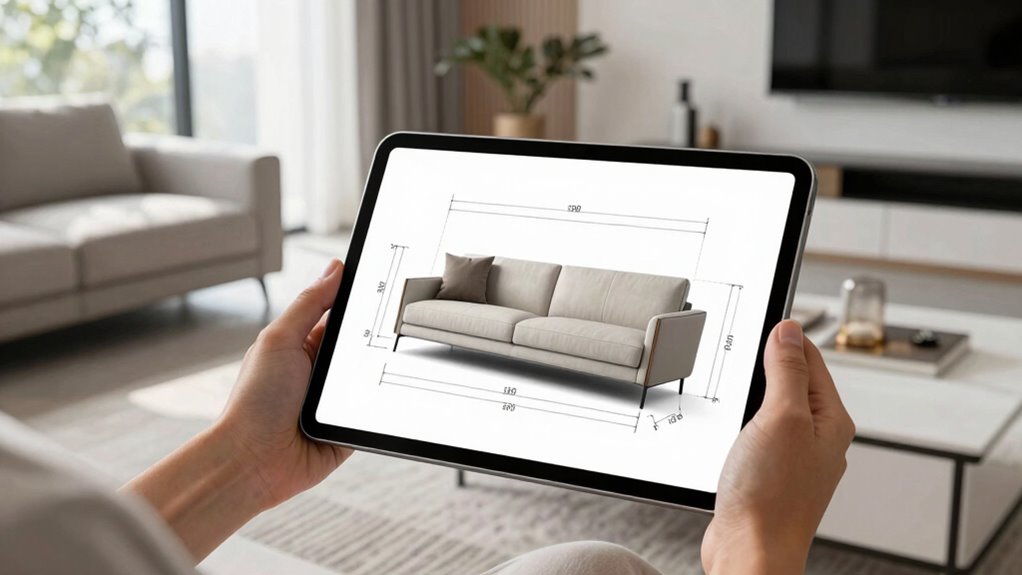

To better understand product dimensions in real spaces, don’t just focus on the numbers—visualize how they fit into your room. Measure your space accurately, considering door swings, windows, and other features. Think about scale and proportion to guarantee furniture complements your environment without overcrowding or appearing tiny. Keep in mind measurement tolerances and clearance zones for a functional setup. For smarter space planning and fewer surprises, continue exploring how to translate dimensions into your actual space.

Get comfort and recovery gear delivered free with Prime
- Fast, free delivery on millions of items
- Prime Video, Amazon Music and more included
- Member-only deals all year
Key Takeaways
- Visualize how product dimensions fit within your actual space, considering room size and layout.
- Cross-check measurements against existing furniture and structural features for accurate planning.
- Account for irregular shapes, door swings, and built-in elements to avoid space miscalculations.
- Compare furniture scale to your room to ensure proportionality and avoid overwhelming or tiny appearances.
- Incorporate clearance zones and tolerance to prevent overcrowding and optimize functional space use.
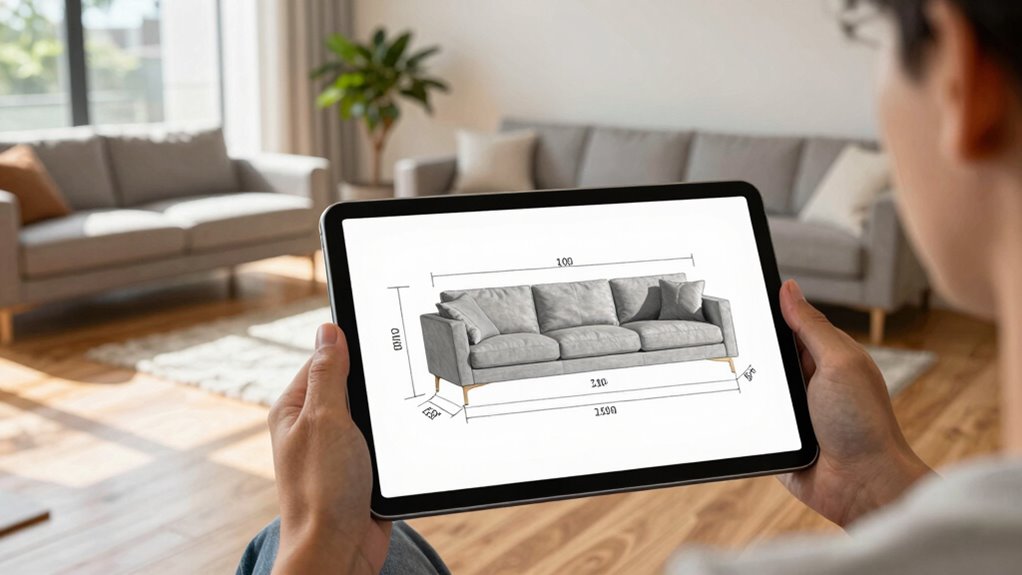
Understanding product dimensions is essential when planning real spaces, but it can often be confusing or misleading if you rely solely on numbers. Dimensions on a product listing may seem straightforward, but they don’t always account for how items will fit into your specific environment. To truly optimize your space, you need a better way to interpret these measurements—one that emphasizes measurement accuracy and considers the actual spatial context. This approach helps you avoid overcrowding or underutilizing your area, making your space both functional and comfortable.
Relying solely on product dimensions can be misleading; focus on measurement accuracy and spatial context for better space planning.
First, don’t just look at the numbers on the product label. Instead, visualize how those measurements translate into your room’s layout. For example, if a sofa is listed as 80 inches wide, you might think it’ll fit easily, but if your room’s width is only 85 inches, you’re barely leaving room for movement or other furniture. Precise measurement assessment involves not only noting the dimensions but also understanding how they interact with existing structures and constraints. By cross-checking these measurements with your space’s actual size, you ensure better space optimization and reduce the risk of purchasing items that don’t fit. Considering spatial context is crucial to making accurate assessments. Additionally, incorporating measurement discrepancy awareness can help you anticipate and address potential fitting issues before making a purchase. Being aware of measurement tolerance can further refine your planning process and prevent surprises.
Measurement accuracy becomes even more critical when dealing with irregularly shaped spaces or multi-purpose rooms. You might measure a corner or a niche, but if you don’t account for door swings, window placements, or built-in features, your planning could be flawed. Relying on exact measurements helps you see the full picture, allowing you to allocate space efficiently. This means you can prioritize essential items, plan for clearance zones, and avoid clutter. When your measurements are precise, you’re better equipped to make informed decisions, preventing costly mistakes and furniture returns.
Another key aspect is understanding the scale and proportion of furniture relative to your entire space. Sometimes, a piece looks perfect in a showroom or online, but in your room, it appears overwhelming or diminutive. Measuring your space and comparing it directly to product dimensions helps you judge scale more realistically. This practice ultimately supports smarter choices, ensuring your furniture complements rather than overwhelms your environment. It also encourages thoughtful space planning, where every item has a purpose and fits seamlessly into the overall design. Recognizing measurement discrepancies can significantly impact your planning, helping you create a harmonious and well-functioning space.
Products Worth Considering

eufy Security Video Doorbell E340 Kit with Chime, 2K Resolution and 8GB Local Storage

eufy Security SoloCam E42 4-Camera Kit, 4K Solar Security Cameras with HomeBase 3

Shark Rocket Corded Stick Vacuum for Carpet and Hard Floors, Gray/Orange, HV301
As an affiliate, we earn on qualifying purchases.
Frequently Asked Questions
How Do I Measure Irregularly Shaped Furniture Accurately?
To measure irregularly shaped furniture accurately, start with custom measurements using a flexible tape measure that conforms to curves and angles. Consider material considerations, like soft fabrics or hard surfaces, to determine the best measuring tools. Take multiple measurements from different angles, recording the widest and tallest points. Use these measurements to sketch a scaled diagram, ensuring you account for all unique contours, so your space planning remains precise.
What Tools Are Best for Measuring in Tight Spaces?
You should use a laser distance meter or a compact measuring tape for tight spaces. Laser distance meters are ideal because they provide quick, accurate measurements without needing much room to maneuver. Measuring tapes are flexible and easy to maneuver around corners or tight spots. Together, these tools make measuring in confined areas more precise and less frustrating, ensuring you get the right dimensions every time.
How Do I Account for Clearance When Placing Furniture?
Think of clearance like the secret passage in a maze—crucial for smooth navigation. When planning your space, leave at least 18-24 inches for walkways and around 36 inches for main furniture pathways. This ensures comfortable furniture arrangement and easy movement. Use precise measurements and visualize your layout, adjusting for door swings and other obstructions. Proper space planning guarantees your furniture fits perfectly without feeling cramped or cluttered.
Can Digital Tools Improve Measurement Accuracy?
Yes, digital tools can markedly improve measurement accuracy. Augmented Reality apps let you visualize furniture in your space, ensuring a perfect fit before buying. Voice Measurement features enable you to quickly and precisely measure dimensions using simple voice commands, reducing errors. These tools streamline the process, making it easier to plan your space accurately, cut down on mistakes, and save time, giving you confidence in your measurements every time.
How Do I Visualize Dimensions in a 3D Space?
To visualize dimensions in a 3D space, you should create scale models or use perspective drawing techniques. Scale models give you a tangible sense of size and spatial relationships, while perspective drawing helps you see how objects relate to each other in depth. Combine these methods to better understand how dimensions translate from measurements to real-world spaces, making your planning more accurate and intuitive.
Conclusion
Understanding product dimensions helps you visualize how items fit into your space, making shopping smarter. Did you know that 78% of online shoppers return furniture because it doesn’t match their expectations? By mastering how to read those measurements accurately, you avoid costly mistakes and guarantee everything fits perfectly. So,, take the time to measure and compare—your space will thank you, and you’ll enjoy a smoother, more satisfying shopping experience every time.